
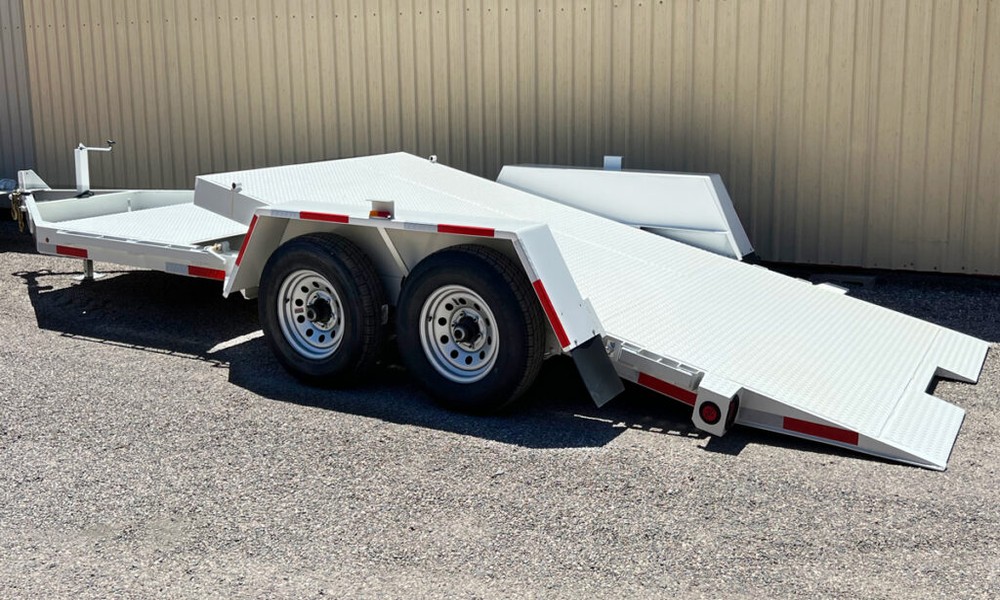
A skid steer weighs anywhere from 5,500 to over 10,000 pounds depending on the model and attachments. Loading it onto a trailer is one of those tasks that looks simple until it goes wrong, and the choice between a tilt deck and a ramp trailer is one of the most consequential decisions a contractor or farmer makes when buying. Grizzly Trailer Sales has helped a lot of buyers in Rupert, Montpelier, and across southern Idaho work through this exact comparison, and the right answer depends more on how you actually use the trailer than on which design is theoretically better. Both work. They just work differently.
How Each Loading Style Functions
A ramp trailer is the traditional setup. The deck stays at a fixed height supported on the axles, and ramps fold down or slide out from the rear to create the incline for loading. Ramps may be single tail-style, dual side-by-side, or a flip-down full-deck design depending on the trailer.
A tilt deck trailer eliminates the separate ramp entirely. The whole deck pivots on a pivot point near the rear axle. The front edge of the deck lifts as the rear drops, creating a single continuous ramp surface from the ground up onto the trailer. Once the equipment is loaded and rolled forward past the pivot, the deck levels back down under the weight.
Gravity tilt trailers use the weight of the load itself to level the deck. Hydraulic tilt models use a powered cylinder to control the angle, which lets the operator manage tilt speed regardless of load weight. Some designs combine both, with hydraulics for the initial tilt and gravity for the return.
Where Tilt Decks Win
The case for tilt trailers comes down to repetition. Loading and unloading a skid steer twice a day, five days a week, makes the difference between a 30-second tilt and a several-minute ramp setup meaningful.
Real advantages tilt buyers tend to mention:
- Loading and unloading is significantly faster
- No heavy ramps to lift, lower, or carry
- A continuous loading surface eliminates the gap between ramp and deck that catches low-clearance equipment
- The loading angle is generally shallower than most ramp setups
- Nothing to forget, drop, or have stolen out of the bed
- Lower-profile equipment like tracked skid steers and mini excavators load more easily
Back injuries from lifting heavy steel ramps are not a minor concern. A pair of solid steel ramps for a heavy-duty equipment trailer can weigh 80 to 120 pounds each. Doing that lift several times a day over a career adds up.
The tilt design also tends to be more forgiving for operators new to loading equipment. The single continuous surface means less precise alignment is required, and the geometry of the loading angle is consistent every time.
Where Ramp Trailers Win
Ramps still have a strong case for many buyers, and writing them off because tilts are trendy misses the point.
Where ramp trailers earn their place:
- Lower upfront cost in most comparable configurations
- More usable deck length for a given trailer length, since no pivot point eats space
- The deck stays flat and stable for hauling pallets, hay bales, vehicles, and irregular loads
- Multiple ramp configurations let you tailor the trailer to specific equipment
- Simpler mechanical design means less to maintain over time
- No hydraulic system to service, no pivot bearings to lubricate
A ranch operation that hauls a skid steer occasionally but uses the same trailer for moving round bales, a side-by-side, fence panels, or a calf chute is often better served by a flat ramp deck. The trailer does more jobs well rather than optimizing for one job.
Cost Comparison
A new tilt deck trailer in the 7,000 to 14,000 GVWR range typically runs noticeably higher than a comparable ramp trailer of the same capacity. Hydraulic tilt models cost more than gravity tilt. The price gap can be anywhere from a few hundred dollars to a few thousand depending on the brand and configuration.
That cost has to be weighed against the time savings and reduced wear and tear on the operator. For a contractor who loads equipment several times per day, the higher upfront cost typically pays back quickly. For an occasional user who hauls a skid steer six or eight times a year, the math often favors the ramp trailer.
Deck Length and Equipment Fit
One detail that catches buyers off guard: the pivot point on a tilt trailer is not at the very rear. The pivot typically sits a few feet forward of the back of the deck, which means a portion of the deck behind the pivot stays angled when the front is tilted up. This affects how long the usable loading surface actually is.
A 20-foot tilt deck and a 20-foot ramp trailer have different effective loading lengths for the same machine. Measuring your equipment, including any attachments that extend forward or rearward, against the actual flat deck space matters more than the advertised trailer length.
For larger equipment like compact track loaders with brush cutters or hay forks mounted, this measurement is the difference between a trailer that works and one that has to go back.
Hydraulic vs. Gravity Tilt
Among tilt trailers, the hydraulic versus gravity choice comes up regularly. Gravity tilt is simpler and less expensive. The load’s own weight controls the descent of the deck.
Hydraulic tilt adds controlled descent regardless of load weight, which becomes a real advantage in two situations: loading very light equipment that wouldn’t tilt the deck on its own, and unloading on uneven ground where gravity tilt can drop the deck faster than you’d like.
For most users hauling consistent equipment weights on relatively flat ground, gravity tilt works fine. For operators handling varied loads or working on irregular surfaces, hydraulic is worth the upcharge.
Other Considerations Worth Weighing
A few practical points that don’t fit neatly into the main comparison:
- Trailer brakes are required in Idaho under Idaho Code § 49-927 once you exceed certain weights, on either type of trailer
- Deck-over construction (deck above the wheels) provides more width but raises the loading angle on ramp setups
- Stake pockets and D-rings matter as much as the loading style for securing equipment safely
- Torsion axles ride smoother and need less maintenance than leaf spring suspension on either trailer type
How Grizzly Trailer Sales Helps Buyers Decide
A walk-through with our team in Rupert or Montpelier usually starts with what you’re hauling and how often. From there, the recommendation between tilt and ramp, between gravity and hydraulic, between 14K and 16K capacity, falls into place. We stock tilt trailers, deckover ramps, car haulers, dump trailers, and gooseneck equipment trailers from brands including Teton, Walton, Snake River, and Dutton, and seeing the units side by side is usually worth more than any spec sheet comparison.
Stop by 305 W 100 S in Rupert or 740 N 4th St in Montpelier, or call Grizzly Trailer Sales at (208) 678-2981 to talk through which loading style fits your operation. The right trailer makes a long day shorter. The wrong one makes every job harder than it has to be.
