
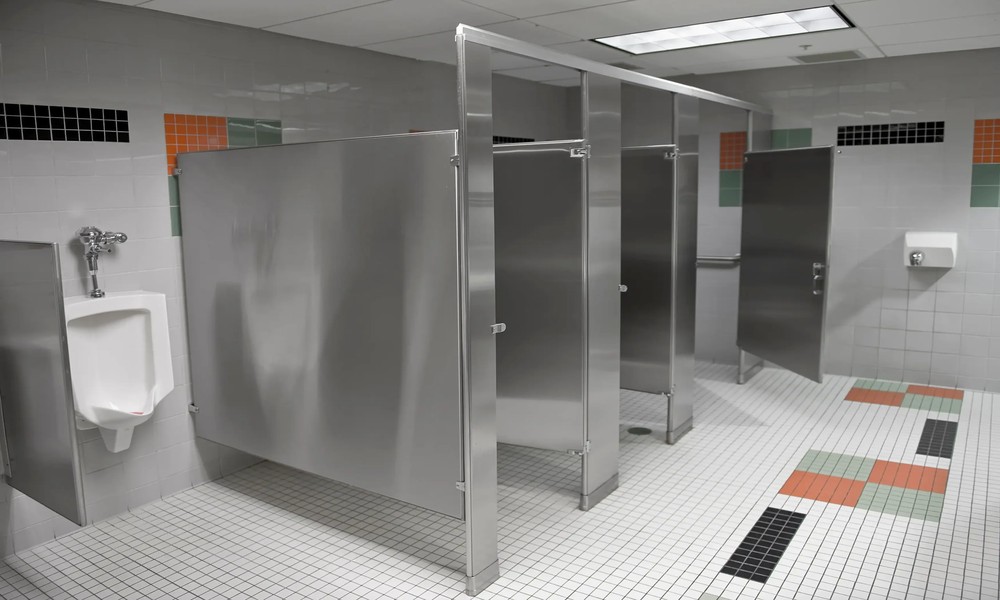
Commercial restroom partition renovation decisions are more nuanced than a simple condition assessment. Partition systems that appear serviceable on visual inspection may have underlying hardware or moisture issues that predict near-term failure, while systems with surface cosmetic degradation may have structurally sound panels that are economically rebuildable.
What Does a Structured Partition Condition Assessment Evaluate?
A structured condition assessment evaluates 4 categories that contribute differently to the replacement versus repair decision:
- Panel surface integrity: ghosting, staining, and delamination affect user experience but do not necessarily indicate structural failure. Surface-only degradation on phenolic or stainless steel panels with intact substrates can be addressed through resurfacing.
- Panel structural integrity: moisture infiltration, core swelling, or delamination that compromises panel rigidity indicates structural failure requiring panel replacement.
- Hardware condition: hinge wear, door strike deformation, and latch mechanism failure typically occur before panel failure and are independently repairable.
- Pilaster anchorage condition: loosened floor brackets and wall anchors are a safety concern that requires immediate remediation regardless of the panel condition.
When Is Hardware Rehabilitation More Cost-Effective Than Full Replacement?
Hardware rehabilitation is economically justified when panel structural condition is sound and hardware failure is the primary performance issue. The cost differential between hardware rehabilitation and full replacement for a standard 10-stall restroom typically ranges from $8,000 to $25,000 depending on the partition material and hardware specification.
Specifiers selecting commercial bathroom partition replacement should use the condition assessment findings to identify whether hardware rehabilitation, targeted panel replacement, or full system replacement is the appropriate scope before proceeding to specification.
When Does Full Replacement Become Economically Justified?
Full partition replacement is economically justified in 3 conditions:
- Panel structural failure from moisture or corrosion has progressed to the point where panel repair costs approach new panel cost
- The existing partition layout requires reconfiguration to meet current ADA requirements that cannot be achieved by hardware or panel rehabilitation
- The existing partition material is inappropriate for the facility’s usage intensity and will produce the same failure pattern in any rehabilitated configuration
How Should the Replacement Specification Address the Original Failure Cause?
When full replacement is selected, the replacement specification should address the performance gap that produced the existing system’s failure. 2 specification errors commonly recur when this step is skipped:
- Projects replacing powder-coated steel partitions that failed from moisture exposure specify the same powder-coated steel material, producing the same outcome within the same timeframe
- Projects replacing standard-hardware systems that failed from high-traffic door cycling specify the same butterfly hinge and strike configuration without upgrading to piano hinges rated for the actual usage intensity.
